Remote Solar Farm Monitoring
Background
Large photovoltaic (PV) installations typically consist of dozens or even hundreds of inverters, energy meters, weather stations, and other monitoring devices spread across a wide area. Operators need to collect data from all of these devices and deliver it reliably to a remote control center, where it is used for performance monitoring, alerting, and maintenance planning.
The task is made harder by two factors. Many field devices communicate over legacy industrial protocols such as Modbus RTU, which modern monitoring platforms cannot consume directly. In addition, PV fields are often located in remote areas where no fixed network infrastructure is available.
Advantech industrial cellular routers from the ICR family address both challenges at once - they connect the field devices locally and provide a secure cellular link to the remote control center.
System Requirements
- Reliable cellular WAN connectivity: LTE uplink with dual-SIM redundancy for sites without a wired connection.
- Serial device integration: RS485 interface for direct connection to PV inverters communicating over Modbus RTU.
- Protocol conversion: Conversion between Modbus RTU and Modbus TCP, and further to MQTT, so that the collected data can be consumed by modern IoT and SCADA platforms.
- Centralized data collection: Collection of operational parameters from multiple inverters, such as power output, voltage, current, inverter status, and energy production.
- Secure data delivery: Encrypted transmission of the collected data to the remote control center.
- Remote management: Centralized configuration, monitoring, and maintenance of the routers without on-site visits.
- Rugged hardware: Industrial-grade device suitable for harsh outdoor environments.
System Description
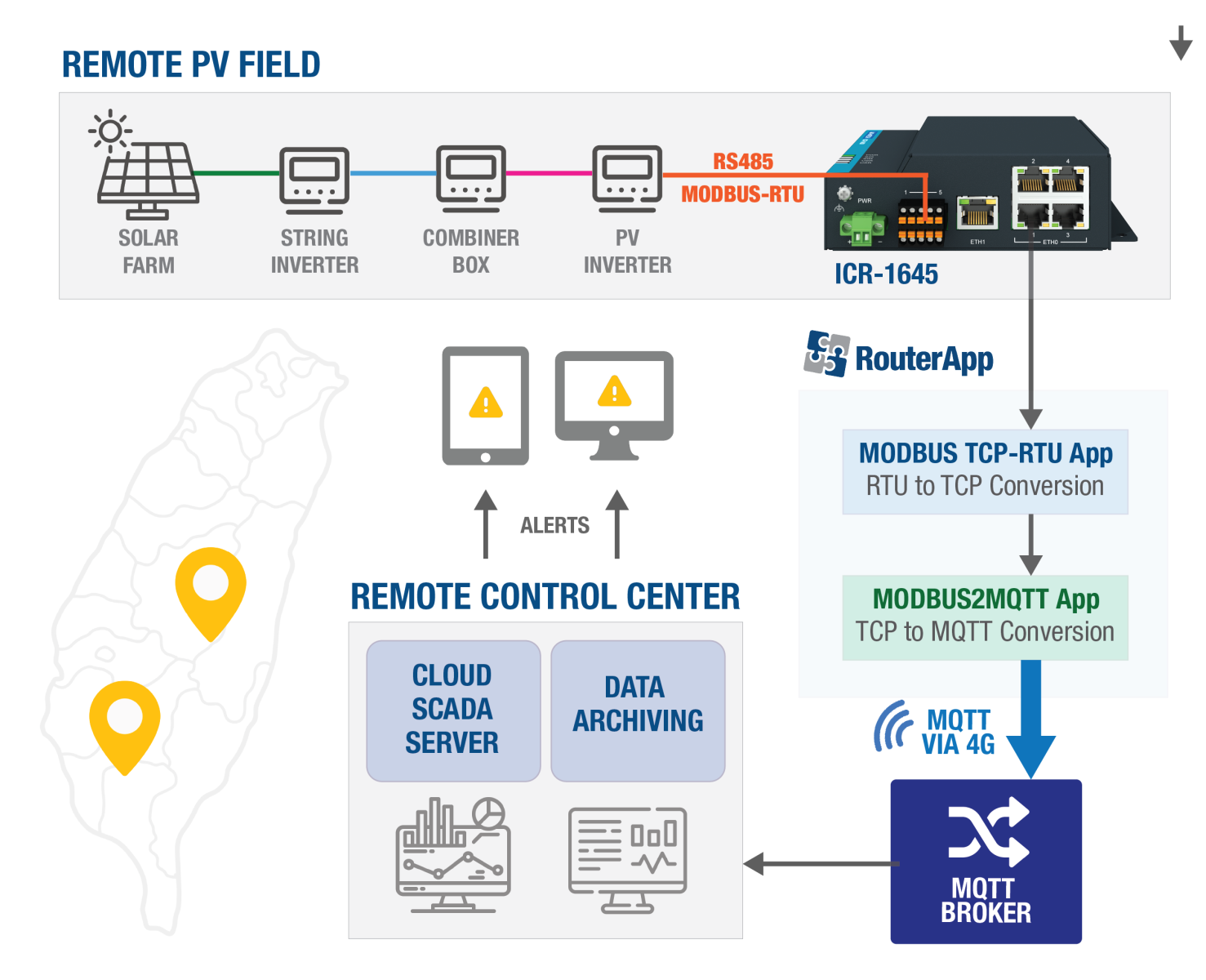
The solution is built around the Advantech ICR-1645 industrial cellular router, which acts as a centralized data acquisition gateway at the PV field. The router is connected to the inverters over RS485 and collects their operational data using the Modbus RTU protocol. The collected data is then processed directly on the router by two RouterApps and sent over the LTE network to the remote control center.
The data path consists of the following steps:
- Data acquisition (RS485 / Modbus RTU): The router reads operational parameters from the PV inverters - such as power output, voltage, current, inverter status, and energy production.
- Modbus TCP-RTU App: Converts the Modbus RTU data from the serial line to Modbus TCP, allowing the serial devices to be accessed over the IP network.
- Modbus2MQTT App: Converts the Modbus TCP data to MQTT messages, a lightweight protocol well suited for IoT applications and cellular links.
- MQTT via 4G: The MQTT messages are transmitted over the LTE network to an MQTT Broker. The router can also act as a local data recorder and MQTT Broker itself.
- Remote Control Center: Data from the MQTT Broker is delivered to the cloud SCADA server and to data archiving, where operators can access real-time and historical performance information. Alerts are presented to operators on their monitoring devices.
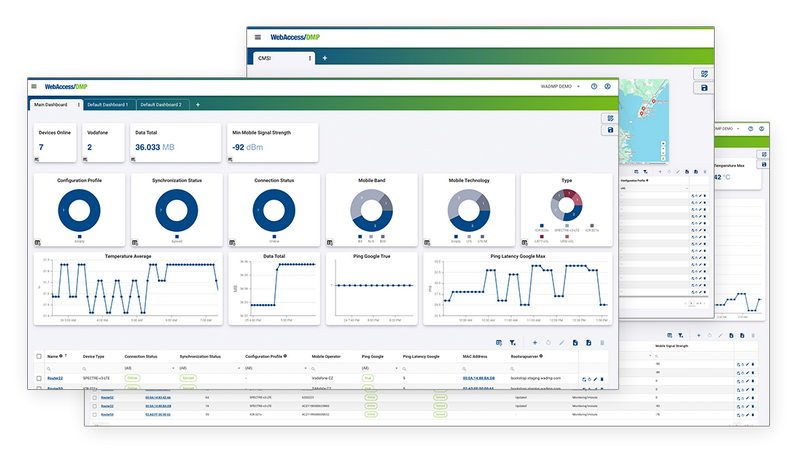
Dual-SIM support provides network redundancy with automatic failover between carriers. All routers can be managed centrally through the WebAccess/DMP cloud platform, which enables remote monitoring, configuration, firmware updates, and diagnostics.
Project Implementation
The router is installed at the PV field and connected to the inverters via the RS485 interface. Communication parameters of the serial line are configured on the router, and the Modbus TCP-RTU and Modbus2MQTT RouterApps are installed and set up to define which inverter parameters are read and how they are published as MQTT messages.
- Field connection: The ICR-1645 is connected to the PV inverters via RS485 and powered from the site's power supply.
- Data collection and conversion: The RouterApps convert the Modbus RTU data to Modbus TCP and then to MQTT directly on the router, so no additional gateway hardware is needed at the site.
- Cellular connectivity: The router connects to the remote MQTT Broker over LTE, with a second SIM card available as a backup connection.
- Control center integration: The SCADA server and the data archiving system in the remote control center subscribe to the MQTT data stream and process it for visualization, alerting, and long-term storage.
- Remote management: The router is added to WebAccess/DMP, allowing the operator to monitor its status and perform configuration changes and firmware updates remotely.
Conclusion
The ICR-1645 allows operators to connect legacy Modbus RTU devices in a PV field to modern monitoring platforms using a single compact device. Protocol conversion from Modbus RTU through Modbus TCP to MQTT is performed directly on the router, and the data is delivered over the LTE network without the need for any wired WAN connection.
The solution reduces infrastructure costs, simplifies the architecture of the remote site, and gives operators real-time visibility into the performance of their solar installations. Dual-SIM redundancy keeps the site connected, and centralized management via WebAccess/DMP minimizes the need for on-site maintenance visits.